If you are searching for a reliable artificial plants wall manufacturer, you need a partner that offers industrial-grade, UV-protected, and fire-retardant vertical greenery systems. As a professional manufacturer HRTrees provides end-to-end solutions, from custom modular panel design to high-durability mounting hardware suitable for large-scale commercial interiors and outdoor facades.
This guide explains our technical structure, installation methods, and scalability of modern synthetic green wall systems.
What Is an Artificial Plants Wall System?
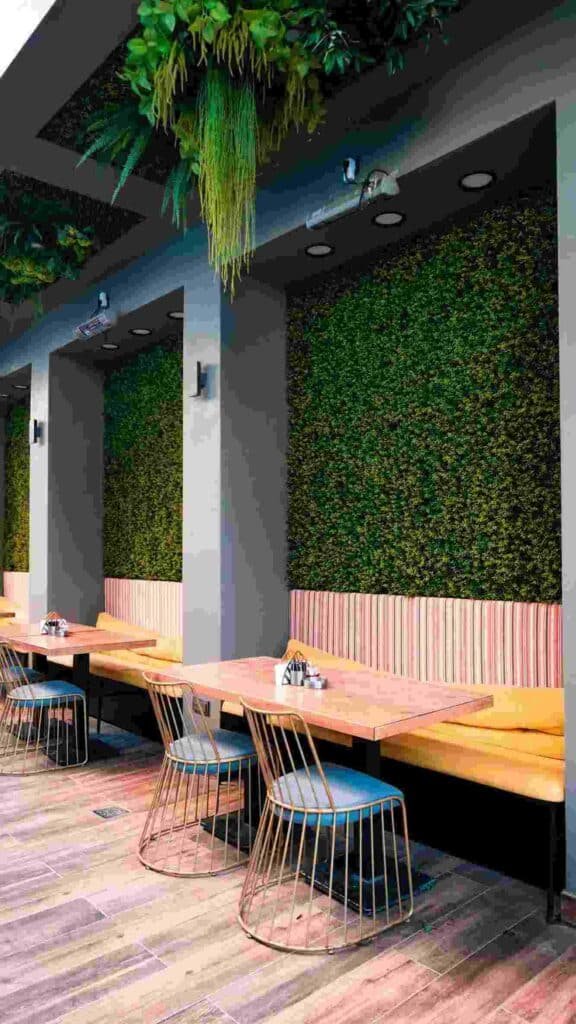
Artificial plants wall system is an architectural, vertical greenery system, which is a high-density and multi-layered system designed to be used long-term. These systems are designed with a heavy-duty mesh or grid support behind the decorative panels, unlike the simple ones used in retail outlets, and can support a wide range of realistic botanical species.
They are designed to resist environmental stressors and also offer an immediate, maintenance free living aesthetic to offices, hotels and retail spaces.
Source: Pexels
- Pre-Made Panels vs. Custom-Manufactured Systems: Pre-made panels come in standard sizes (often 50x50cm or 100x100cm) with a fixed foliage pattern, making them great for quick setups. Custom systems are however modified by the manufacturer to suit certain dimensions and include different heights and textures of foliage to prevent the appearance of a cookie-cutter.
- Artificial Plant Walls vs. Living Green Walls: Living walls need complicated irrigation, drainage and regular pruning. Artificial systems, on the other hand, have the same biophilic advantages but with no danger of water damage, pests, or high monthly maintenance costs.
Commercial Installation and Structure of Artificial Plant Wall
The installation of a commercial grade of green wall needs a good knowledge of load bearing structures and compatibility of the surface. Being one of professional artificial plants wall manufacturers, we make sure that the foliage is supported by a chassis that is capable of supporting the weight and wind pressure of a commercial busy setting.
A- The Chassis Systems
The chassis or skeleton of a good plant wall supports the foliage and the weight of the foliage is safely transferred to the building surface. In the case of heavy-duty projects, manufacturers may opt to use powder-coated steel grids which are strong and resistant to corrosion. Polymer reinforced backings are less heavy and can be used on the interior walls where the load restrictions are more stringent.
Most manufacturers use one of these approaches:
- Integrated grid systems: Panels lock into a pre-aligned grid fixed to the wall.
- Rail Systems: These enable the panels to slide in place and hence are easy to replace in case you wish to change the design in the future.
- Direct Mounting: Ideal in permanent fixtures where the grid is attached to the substrate by screw.
- Freestanding Frames: These frames are designed to be used as room divans or temporary event backdrops and are weighted on the bottom to prevent them from being attached to a wall.
B- Surface-Specific Mounting
Every wall surface has its own “mood.” You cannot work a glass partition like a concrete pillar.
- Concrete/Masonry: We use heavy-duty masonry anchors and sometimes a timber battening layer to create a flat surface.
- Drywall: It is important to distribute the load. The panels are held in place by z-clips, or special toggle bolts so that they do not grab chunks of the wall.
- Glass/Metal: In the case of glass we tend to use high strength adhesive stand-offs or suction based mounting systems which do not impinge on the transparency of the surrounding area.
C- Foliage Density and 3D Volumetric Design
Realism comes from depth, not just color. High-quality manufacturers measure “Leaves Per Square Meter” to ensure no “bald spots” are visible.
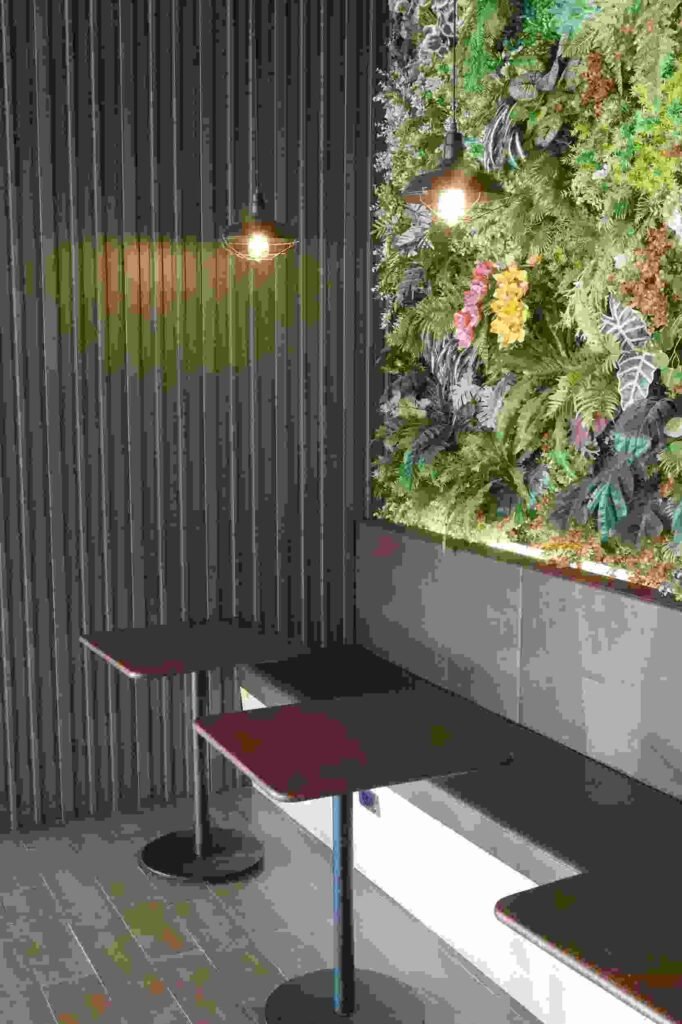
- Species Layering: By mixing long-trailing ferns with tight boxwood and “popping” larger leaves like Monstera or Palm, we create a 3D effect.
- Visual Depth: A flat screen appears unnatural. A volumetric design involves the application of varying lengths of stems (between 5cm and 20cm) in order to make the wall appear lush in all directions. The wall is given shadows and variation through the overlay of vines, shrubs, and accent leaves and resembles natural growth.
All this planning is usually done at the manufacturing stage, not on-site, to keep quality consistent.
Source: Pexels
D- The “Ventilated Facade” Approach for Outdoors
For outdoor installations, airflow is your best friend. When you seal in the moisture between a plastic material and a wall of a building, you will have mold and structural rot.
- Air Gap: This is a small space (typically 20-30mm) between the building envelope and the plant wall.
- Thermal Regulation: This gap also serves as a thermal insulation layer, which ensures the building is cooler during summer and does not allow dampness to be deposited on the facade.
The Modular Artificial Plant Wall Solutions: Scalability for Large-Scale Projects
The secret to covering large areas without having to pay a fortune in labour is the modular systems. By breaking a giant wall into manageable “blocks,” manufacturers make shipping easier and installation much faster. This scalability makes it so that a 100-square-meter wall appears as smooth as a small 2-meter feature.
- Maintenance: In case one part is damaged, you will replace that particular part and not the entire wall.
- Cost Efficiency: Mass production of the modular parts is done under high quality control and this reduces the price per square meter of large projects.
Interlocking Panel Logic (Plug-and-Play)
To avoid those ugly vertical lines where panels meet, manufacturers use interlocking teeth or “male-female” connectors. These connectors draw the panels close to each other and the foliage that protrudes conceals the seams to the fullest extent. It is similar to a puzzle in which the pieces are lost after clicking in.
Customization via “Color & Texture Boxes”
To keep things unique, we use a “Base + Pop” method.
- Modular Base: A standard, high-density green panel (the “A” panel).
- The Pops: Hand-placed “texture boxes” containing colorful flowers or exotic leaves are added on-site.
- Pattern Coding: It is common to see manufacturers labeling panels as A, B, and C. By rotating these during installation, we ensure that the same “swirl” of leaves doesn’t repeat every few feet, which is the biggest giveaway of a fake wall.
What Does a Professional Artificial Plants Wall Manufacturer Provide?
There are more stringent requirements on scale, safety and durability when you move beyond residential “DIY” decor.
As a top-tier artificial plants wall manufacturer, HRTrees is not just a supplier; we’re an engineering partner. We offer technical documentation, safety certification and custom design services required to pass building inspection and achieve long-term project objectives.
1- Design, Engineering, and Customization
It begins with an in-depth consultation to get the feel of your space and technical requirements of your space using drawings, site photographs, or architectural plans.
This stage includes:
- Visual layouts and elevation drawings
- Selection of botanical species that match your local environment or brand identity
Specifications are written in a clear manner, therefore, architects, contractors, and installers use the same reference. Customization may go as far as minor texture adjustments or complete brand-specific plant palette, so that the end product is not another generic green square, but a custom architectural element.
2- Structural & Load Calculations
For high-rise buildings or exterior facades, “winging it” is not an option. Wind-load testing is done to make sure that the panels will not blow away in a storm.
We also determine the weight of the system itself (the dead load) to make sure that the current wall or sub-frame can hold it. We also liaise with your HVAC crew to make sure that the wall of the plant does not block the air returns or create turbulence in the ventilation system.
3- Meeting Local Fire and Building Codes Requirements for Artificial Plants Walls
Fire safety is a priority in commercial areas. Being a professional manufacturer we offer products that are ASTM E84 Class A or Class B fire rated.
This implies that the foliage is fire retardant by nature (IFR) – the chemicals are incorporated into the plastic when it is being molded, and it will not be washed out with time. It is always advisable to request such test reports to remain in line with local fire marshals.
4- Estimates on Duration, Cost and Requirements
We provide you with a definite schedule, starting with the prototyping (23 weeks), mass production and shipping (48 weeks).
We also give labor estimates, which explains the number of man-hours required to install. This will assist you in dealing with site interruptions, particularly when the installation is being done in an operational office or hotel lobby.
Real-World Commercial and Engineering Case Studies
The best method of determining the ability of a manufacturer is to see how these systems work in the wild. In silent offices and sunny roof tops, here are some of our systems that address certain spatial issues.

Source: Pexels
1- Corporate Offices and Commercial Interiors:
In a recent technological office development, the acoustic problem was solved by a 20-meter plant wall. The synthetic leaves were irregular and this contributed to the diffusion of sound waves, which minimized the echo in an open-plan area.
Moreover, the backing made of recycled materials assisted the project in gaining additional points in its LEED certification as a sustainable interior design.
2- Hospitality, Retail, and Public Spaces:
The high-UV rooftop bar needed greenery that would not become blue or dry. The manufacturer offered foliage with UV-Max rating, which was subjected to 3,000 hours of accelerated weather conditions. The wall is still bright two years later, which confirms that UV stabilizers of industrial grade are worth the investment in high-traffic and outdoor areas.
3- Large-Scale or Outdoor Retail Branding:
In the case of a flagship retail store, the manufacturer incorporated a 3D acrylic logo into the wall of the plant. They employed recessed mounting, in which the foliage was clipped around the signage in a particular manner to ensure that the brand name was not lost in the foliage. It was also painted with custom colored foliage to match the brand specific pantone green.
Expert Tips for Planning a Successful Artificial Green Wall Project
To get the best result from your artificial plants wall manufacturer, you need to look at their credentials.
- Do not believe in pretty pictures, seek factory standards such as ISO 9001 (quality management) and BSCI (social compliance).
- Confirm that it complies with REACH or RoHS so that the plastic does not have heavy metals or toxic chemicals that may off-gas in a closed office.
- Discussing with the factory, you have to determine whether you require OEM (Original Equipment Manufacturer), in which they assemble your design, or ODM (Original Design Manufacturer), in which you choose one of their existing designs.
- In case of high-end commercial tender, request a control sample or 1×1 meter prototype. This will enable you to check the colour and the leaf density on your own site lighting before committing yourself to a 500 unit order.
- Lastly, always request 5 percent more “buffer foliage” to future proof against inadvertent harm in the future renovations.

Source: Pexels
Key Takeaways – Evaluating an Artificial Plant Wall Manufacturer
Finding the appropriate artificial plants wall manufacturer entails a compromise between engineering and aesthetics. HRTrees provide you with certified fire retardancy, UV-rated materials and scalability on-demand. We guarantee that your vertical garden is a low-maintenance, high-impact asset over the years by concentrating on the best technical standards.
To get more technical specifications about industrial grade wall panels, send us a message for a quick consultation with our expert team directly.
FAQs

Q: Are artificial plant walls suitable for outdoor use across US climates?
Yes, but only when they are “Outdoor Rated” In states such as Arizona, you must have high UV protection to avoid fading. In states with lower temperatures such as Illinois, the support should be adaptable so that it does not snap in a freeze-thaw cycle. Never forget to look at the temperature rating of the manufacturer so that you can ensure that the plastic will be able to endure your local weather and not become brittle.
Q: How long do artificial plant walls typically last?
In the case of indoor installation, a good wall can be easily maintained at 10 to 15 years with a simple dusting. In the case of an outdoor wall, the expected lifespan of the wall is 5 to 8 years of prime looks, depending on the sun exposure. The majority of professional manufacturers offer a 3-year or 5-year warranty on any major fading and this gives you a good peace of mind in your investment.
Q: Can artificial plant walls be expanded or relocated later?
Flexibility is one of the most appropriate aspects of modular systems. Given that the panels are typically fixed on a grid or rail system, you can unclip them and transfer them to a new office in case you change. Should you wish to expand the wall in future, a professional manufacturer will be able to replicate your initial foliage recipe.
Q: How much customization can manufacturers provide?
Quite a lot! You aren’t stuck with just green. You can specify the percentage of “flowering” plants, the length of trailing vines, and even the “soil” look at the base. Some manufacturers can even create “branded” walls where different shades of green are used to subtly form a logo or a pattern within the foliage itself.
Q: What is the lifetime of artificial vs. living walls?
While a living wall can technically last “forever” if perfectly maintained, many fail within 1–2 years due to irrigation issues or lighting gaps. Artificial walls provide a “guaranteed” look for 5–10 years with zero water or specialized light. When you factor in the cost of dead plant replacement for living walls, artificial systems usually pay for themselves within 18 months.