
Are you evaluating whether to install live or artificial palm trees at your commercial location? If yes, we will guide you through it. Planting real trees comes with various constraints, such as climate conditions, irrigation costs, and regular maintenance. Artificial palm trees, on the other hand, come ready to impress without requiring any specific climate or maintenance.
This article discusses everything you want to know before placing an order for outdoor artificial palm trees. From palm styles to structural details and commercial applications, we have listed everything below.
Why Choose Artificial Palm Trees For Commercial Projects
Real palm trees are demanding and fragile. You cannot take the risk of a specimen failing and throwing an entire row of palm trees on a large commercial project. It leaves your space looking uneven and requires time and perfect weather conditions to regrow the plants.
Artificial trees eliminate all these variables, giving your space a long-term green look. The following are the factors why you must choose outdoor artificial palm trees for your location:
- Low Maintenance: The most convincing factor is that these trees are a one-time investment. Once you install them, they will only need occasional cleaning. No pruning schedules, irrigation systems, or replacement costs involved.
- Uniform Quality: Real plants change their appearance throughout the year. Some months they are green and fresh; in autumn, they become dry and uneven. Artificial palm trees remain fresh and appealing regardless of the season.
- Quick Installation: Artificial units arrive, ready to install. Unlike live palms, which require a root establishment period or the planting season.
- Location-friendly: Artificial palms can be placed anywhere, including atriums, poolside zones, or rooftop terraces. Unlike the real palms, which can only be planted in irrigated land.
Artificial Palms: Styles and Structural Components
If you have decided to install artificial palm trees, the next question is, which type or specifications would suit your location? The primary differences between commercial and consumer-grade palm trees lie in their materials, structural design, and finishing standards.
Let’s learn about structural components and style variations in outdoor artificial palm trees to help you place the correct order:
Components of a Commercial-Grade Outdoor Palm Tree
An outdoor faux palm tree designed for a home patio is not the same as a unit built for a resort pool deck. Different materials and structural standards are used in commercial units to ensure they withstand harsh conditions.
For example, a fiberglass or high-density polyethylene trunk is durable and best suited for outdoor installation. Similarly, a galvanized internal frame is the backbone of tall units, preventing them from leaning.
Another primary component is the base of your commercial artificial palm trees. A concrete ballast planter remains stable under load and is ideal for busy locations such as pool decks, lobbies, and driveways.
Buyer Tip: Confirm that your artificial palm tree manufacturer uses UV treatment at the material stage, infused into the polythene (PE). Do not go for sprayed surface coating as it peels off and degrades over time.
Palm Styles Used in Commercial Projects
Selecting the right palm style is as crucial as ensuring the quality of its components. The most common mistake made by commercial buyers is choosing the wrong silhouette that ruins their project’s entire look.
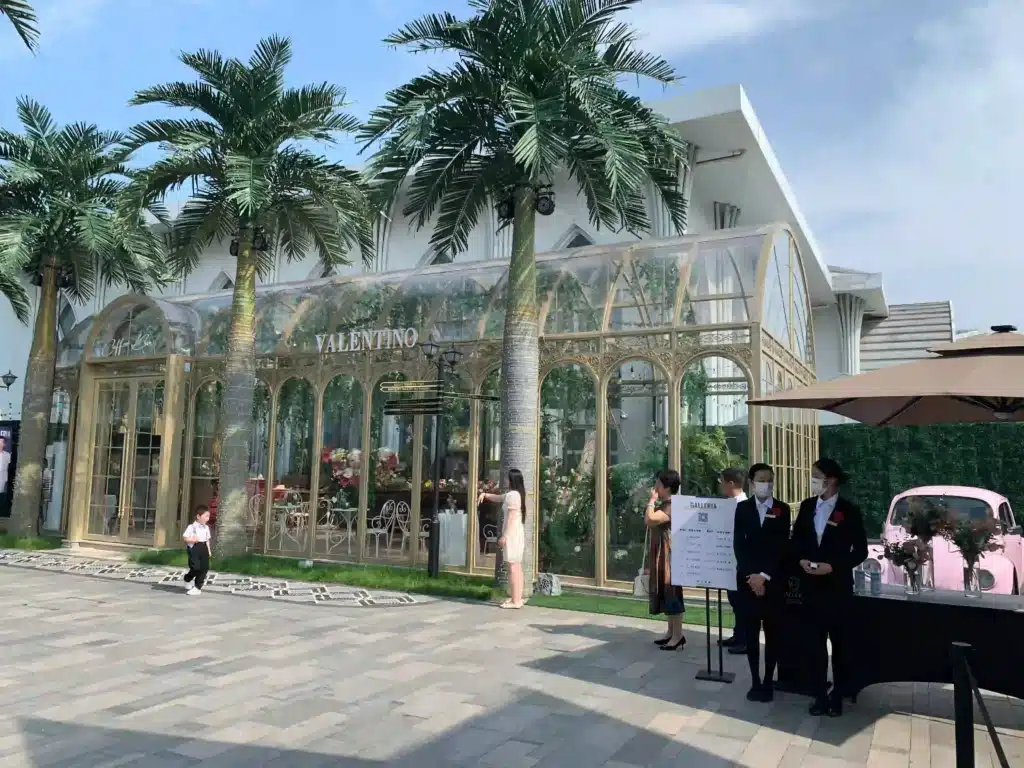
A single-trunk coconut palm that works as a focal point at a beachfront resort looks completely awkward in an indoor atrium. Therefore, the placement, height, and nearby architecture play a crucial role in determining the styles of artificial palm trees you should choose.
Read the table below to find out the palm styles for your location:
| Palm Style | Common Height Range | Best Application |
| Single-trunk coconut palm | 3m – 10m | Resorts, hotels, pool decks, and outdoor event spaces |
| Multi-trunk cluster palm | 2m – 5m per trunk | Mall atriums, covered lobbies, and restaurant interiors |
| Date Palm | 4m-8m | Formal commercial landscapes and hotel entrance roads |
| Washingtonia palm | 5m-12m | Large outdoor plazas, theme parks, and resort driveways |
| Areca/butterfly palm | 1.5m – 3.5m | Semi-outdoor corridors, covered walkways, and F&B terraces |
Trunk finishes also vary within each style. Some projects prefer bark-finished trunks, while others require coarse-textured bark for a natural look.
Buyers sourcing custom artificial trees should provide reference photos or descriptions early in the RFQ process to ensure the correct trunk style and canopy width are quoted.
The Most Important Outdoor-Grade Materials In Artificial Palm Trees
Outdoor plants are constantly exposed to conditions like sun exposure, strong winds, and dust. A foliage made with low-grade materials will easily fade and deteriorate under such conditions.
Therefore, it is significant for buyers to learn about the materials they are investing in. The following is a list of the four main components of artificial palm trees and the materials that increase their lifespan.
Foliage
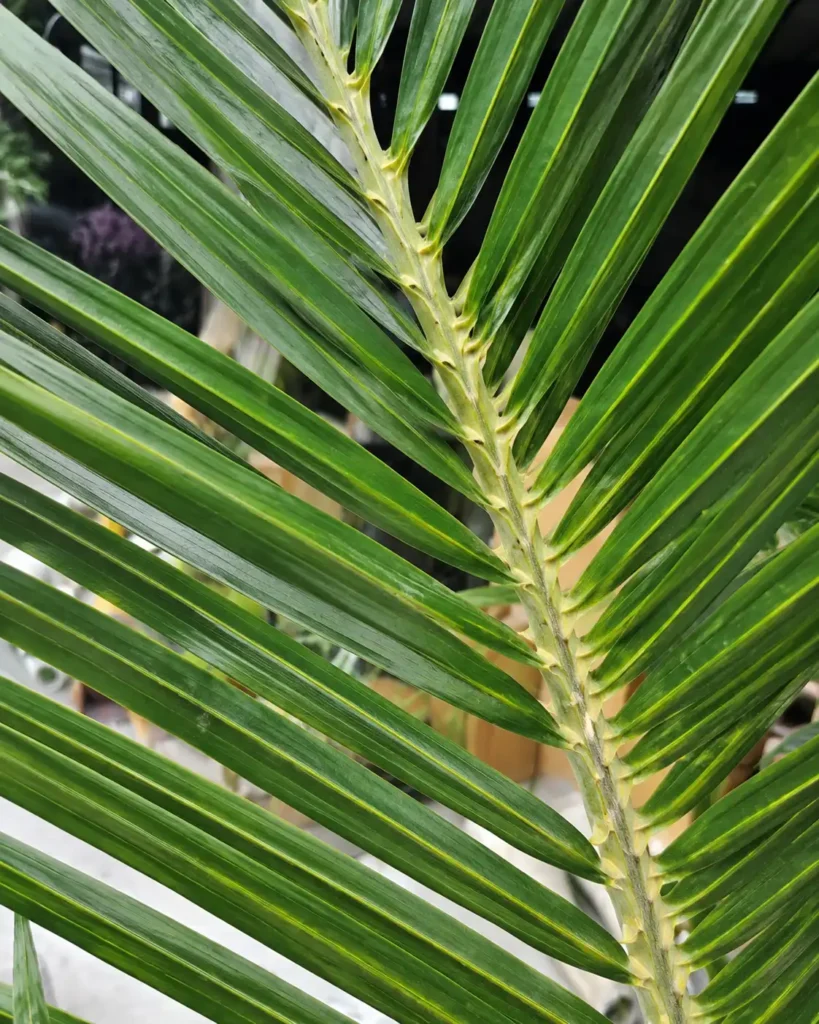
The most fragile part of an outdoor artificial palm tree is its foliage. Direct sunlight can bleach PE plastic in just one season, unless the material contains UV inhibitors. Silk fronds are strictly for indoor installations. They fade quickly and are not appropriate for outdoor commercial applications.
For direct sun exposure, confirmed material-stage UV treatment in PE plastic is the only acceptable specification. There is an important distinction between artificial planters that buyers need to understand before ordering:
- Outdoor-safe: This means the unit is suitable for a covered patio or a shaded, semi-outdoor environment where direct sun is occasional or limited.
- UV-resistant artificial palm tree: The foliage of these units is made from PE plastic with UV inhibitors added during molding. This is what you need for any fully exposed outdoor commercial installation.
Leaf Density and attachment quality also matter for the longevity of your outdoor palms. Loosely attached fronds shift in the wind and begin to look worn within the first year. Whereas, well-distributed and securely fixed fronds hold their shape across years of outdoor use.
Frame Level
Hot-dip galvanized or powder-coated steel frames are commonly used for outdoor commercial installations. For artificial palms above 3 meters, this core carries the canopy load and resists wind pressure.
The weld quality, steel wall thickness, and corrosion protection methods must be confirmed with the artificial palm tree manufacturer to determine how the units will perform:
Note:For units above 4 meters, buyers must provide written frame specifications. Product photos or references alone are not sufficient for accurate evaluation.
Trunk
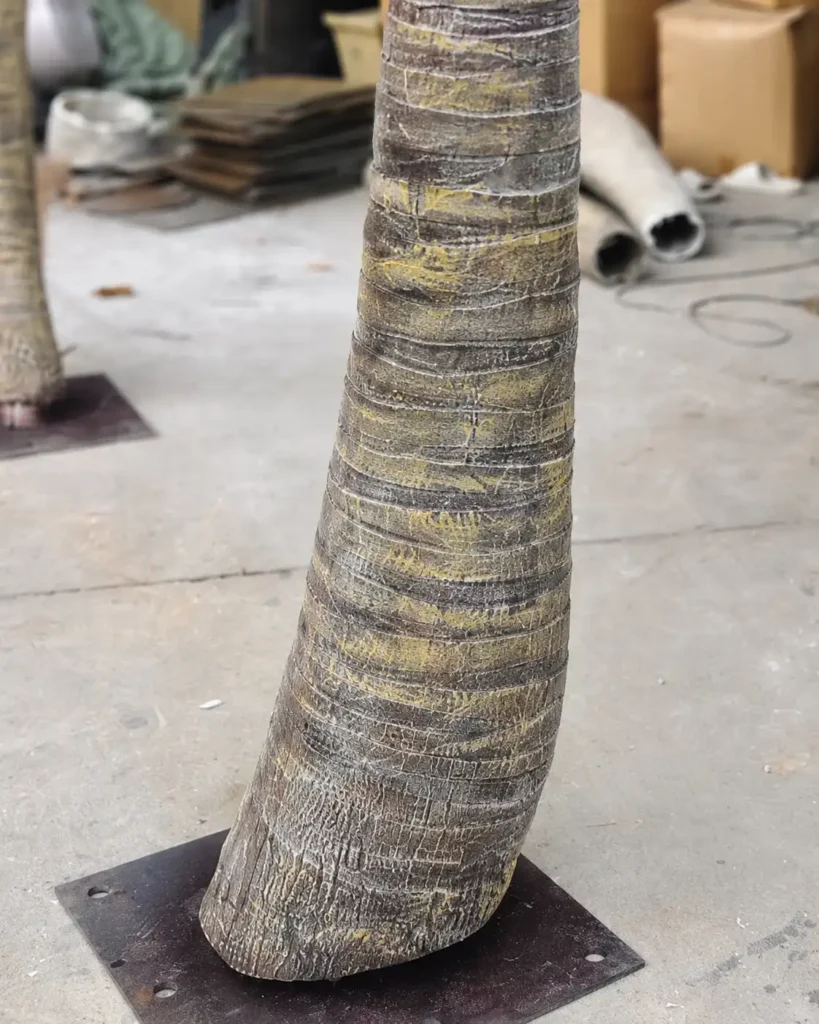
A fiberglass trunk is a preferred choice for commercial landscape projects. It’s lighter than concrete and retains realistic surface detail across large runs. That consistency matters when you want every unit in a bulk order to look uniform.
Base
A weighted base is vital for any outdoor open space. Without proper ballast, units become unstable in strong winds. The common base options for commercial projects are:
- Concrete-filled planters: These are standard for permanent poolside and terrace installations
- Ground-anchor bolt systems: This type is used on concrete and paving, where the unit is permanently fixed
- Ballast-weighted decorative pots: Suitable for semi-permanent placements that may need repositioning.
The Most Common Commercial Settings For Outdoor Artificial Palms
Once you have understood the materials and structural details about outdoor artificial palms, it is time to assess your specific installation conditions. Different commercial environments create different performance demands. A shopping mall and a beachfront resort, for example, are both outdoor locations but have different characteristics.
Let’s discuss the most common commercial settings so you can select the correct style of artificial outdoor palm trees for your project:
Pool Decks
Poolside factors like chlorine splashes, sustained humidity, direct sun, and constant foot traffic put serious demands on your artificial plants. In this condition, UV-treated foliage and a rust-resistant internal frame are both required.
For coastal resort setups, salt air rapidly corrodes standard hardware. Therefore, the use of stainless steel fixings and hot-dip galvanized frames is recommended.
Shopping Mall Greenery
Ceiling heights, floor load limits, and visual consistency are some important considerations in shopping mall settings. Buyers managing multi-unit mall programs usually require strict consistency in canopy density, trunk finish, and foliage color across every unit. Fire compliance requirements also vary by market.
Restaurants and F&B Terraces
Most restaurant buyers consider compact potted palm units to create visual separation between dining areas without overcrowding the space. A row of outdoor faux palm trees creates a tropical atmosphere without a horticulture budget. This kind of look holds year-round and can be repositioned easily.
Events and Rental Operators
This segment of commercial buyers prioritizes speed and portability. A lightweight design and a base system that enable quicker transport work best here. Units with removable planters and modular canopy sections are ideal
What Cruise Ship Atriums and Airport Terminals
Two things matter most in these environments: a secure anchoring so that units cannot be knocked over by passenger contact and a realistic appearance that holds up under continuous artificial lighting. These locations have no natural sunlight to rely on, so the product must look convincing under fluorescent and LED lighting.
Things to Decide Before You Order: Size, Space, and Base
The height of your artificial palm trees affects freight cost and assembly requirements, while the spacing influences the final visual look. Base configuration determines whether the installation even works on the surface you have. Buyers need to sort all three before placing the order.
Height Guidelines for Commercial Palm Installations
The height of your artificial palm trees affects the visual outcome and logistics. Units above 6 meters are typically shipped in sections for on-site assembly. That increases the installation time, labor cost, and packaging volume per unit.
Moreover, the container loading calculations and overall freight costs are also influenced. Consider including these numbers in your project budget early on.
The following are height guidelines for outdoor artificial palm trees in commercial locations:
| Commercial Setting | Recommended Height | Notes |
| Hotel entrance driveways | 4m-6m | Offers a solid presence without needing specialist lifting equipment |
| Pool decks and F&B terraces | 2.5m-4m | Suits most outdoor hospitality settings at this scale |
| Large plazas and theme parks | 8m-10m | Below this height in a large open plaza, plants look undersized |
| Mall atriums and covered lobbies | Depends on ceiling clearance | Multi-trunk cluster styles create more visual volume at moderate height |
Spacing Rules To Keep Installations Looking Natural
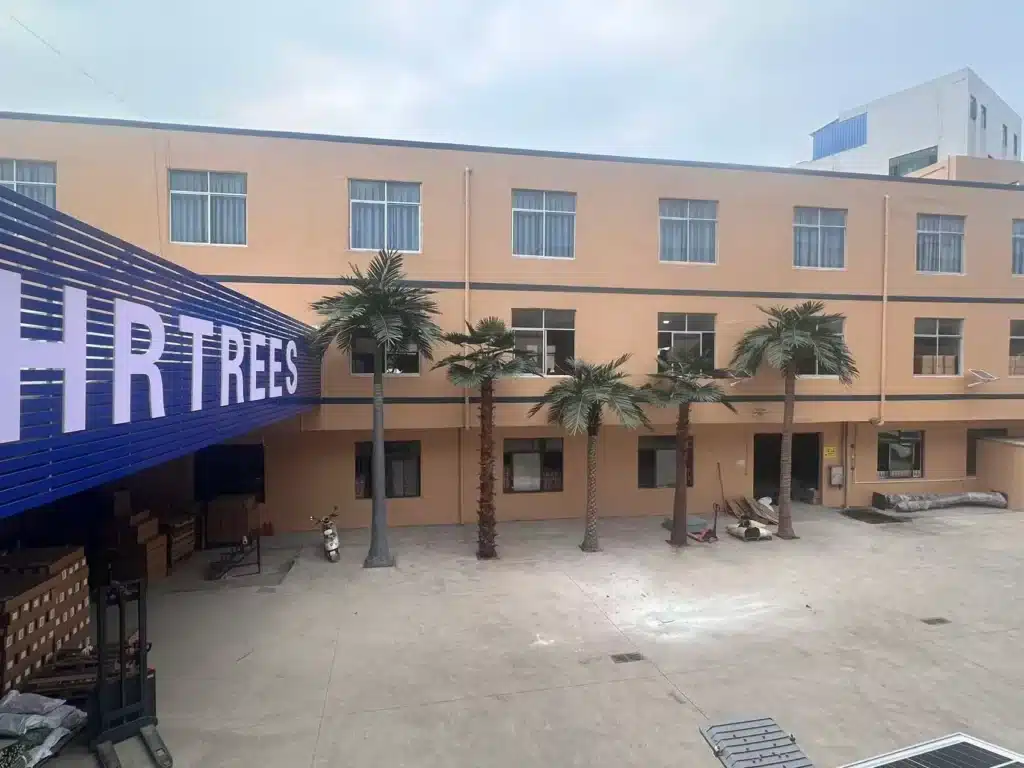
The spacing for your artificial palm trees should be calculated using canopy spread rather than trunk diameter alone. Overcrowded layouts reduce realism and may interfere with pedestrian movement, signage, or lighting systems.
For most commercial landscape projects, the spacing standard is:
- Row plantings along driveways or walkways: 2m – 3m center-to-center
- Clustered groupings in open plazas: Allow at least one full canopy width between units
- Atrium and lobby placements: Measure ceiling clearance first, then work down to the right height and canopy spread
Select the Right Base and Planter for Your Surface
Most commercial buyers make anchoring decisions last; however, it must be made before manufacturing starts.
Before placing your order for outdoor artificial palm trees, confirm the following three things:
- The exact surface the planter will sit on
- Whether the installation will be permanent, semi-permanent, or removable
- Determine if the planter exterior requires a specific finish to align with the project’s design.
OEM and ODM Options for Custom Artificial Palm Trees
Not every commercial project fits a standard catalog. Resort developments, themed attractions, and hotel groups with specific design identities often require precision.
Producing custom artificial trees to meet the buyer’s specifications is a primary skill for artificial plant manufacturers in the commercial market.
OEM Customization
With this option, buyers can specify trunk height, canopy diameter, leaf density, frond style, and planter finish against their own drawings or reference photos.
ODM Service
This category goes further. The plant manufacturers take a concept sketch or reference representation and develop the product from the ground up. It is the service level that resort and themed attraction projects require.
Pre-Shipment Inspection Points for Outdoor Palm Tree Orders
For any commercial order, a pre-shipment inspection is necessary to avoid extra expenses. We have listed below some key checkpoints that every commercial client must inspect:
- Foliage: Demand written confirmation of UV treatment. Also, check the PE grade and inhibitor level on the material spec sheet
- Trunk: Check paint and finish consistency in the batch
- Frame: Weld quality, steel wall thickness, and corrosion protection method must be clarified.
- Base: Verify weight, stability, and drainage solution.
- Packaging: Confirm padding, bracing, and carton condition before sealing.
Commercial buyers sourcing UV-resistant artificial plants for outdoor use must request written material specification sheets. Video documentation of finished goods prior to container loading is a reasonable request that all professional manufacturers fulfill.
What To Include In Your RFQ To Get an Accurate Quote
A complete brief gets a useful quote in one exchange rather than five. Include the specific palm style you want. Also, mention the usage environment and destination country for an accurate quotation.
Other details that you must include in your RFQ are finished height per unit, quantity, and preferred planter type. Attaching Reference photos of the site or the design brief can also help manufacturers understand your requirements.
Frequently Asked Questions
Do outdoor artificial palm trees require any treatment before installation?
No special preparation is needed before installation. Units arrive ready to place. However, for permanent outdoor installations, confirm that the anchoring hardware is tightened and the base is secured to the surface.
Is it possible to replace the foliage if it gets damaged after installation?
Yes, on most commercial-grade units, fronds are detachable and can be replaced individually. Consider confirming it with your artificial plant supplier before placing your order.
How can I determine if a supplier’s UV treatment will withstand outdoor conditions?
Do not believe in a verbal or catalog claim; instead, ask for the material specification sheet. It should state the PE grade and UV inhibitor concentration used in the foliage.
Ready to Source? Let’s Talk About Your Project
HRtrees is a China-based manufacturer specializing in large-scale artificial palm trees and commercial greenery for international clients. We work with hotel developers, resort designers, landscape contractors, and purchasing managers worldwide.
Send an inquiry with your project’s brief, and we will provide product specifications, unit prices, sample order availability, and confirmed lead times.
Contact HRtrees today to find the right product and elevate your commercial space.


