
An artificial ficus tree is the best choice if you have problems with low light or you need a low-maintenance method to make your home brighter. However, there are so many varieties and styles that it can be difficult to understand which artificial ficus trees are best for your house.
This guide introduces the most popular ficus types, where they fit best, and how to select a high-quality tree that elevates your interior decor.
Why should you trust us?
As a top artificial plants manufacturer in China, our reviews are informed by the very machines and materials that create these products. We analyze the market from a builder’s perspective, focusing on the structural integrity and aesthetic realism of each plant.
Our research is deep and unbiased and designed to serve the interests of both home and business clients who need dependable decor solutions. So when we recommend a product, it’s only when it meets industry standards and our own high internal benchmarks.
Our selection criteria
In order to compile this list, we considered dozens of models in terms of three fundamental pillars:
- Visual Realism: We put more emphasis on trees with multi-colored leaves, natural trunks (as in real wood), and branching that resembles natural growth.
- Material Integrity: We seek high-quality PE, Real-Touch finishes, and UV-resistant finishes that do not fade or fray with time.
- Structural Stability: Any recommendation should have a weighted base and a balanced canopy to make it safe in traffic-prone places.
By combining manufacturing insights with current interior design trends, we ensure these selections offer the best value and style for modern homes.
15 Best Artificial Ficus Trees In Various Varieties and Styles
Different ficus varieties give very different looks. There are soft and airy ficus, bold ficus, and truly dramatic ficus that overpower a place. You must learn what fits in your space and aesthetic requirements prior to buying.
1- Ficus Benjamina: Best Artificial Ficus Tree for Lush Greenery
This is the all-time favourite ficus type, seen around homes and offices. It has thick, cascading foliage and small, often sharp leaves, which provide a full and lush look.

- Look & Vibe: Its branches are usually scattered widely and very lightly, and are good in filling those corners, or in smoothing the lines created by modern furniture.
- Placement: It is usually a very tall artificial ficus tree, but also comes with thick canopy appropriate to add privacy or visual mass.
2- Ficus Lyrata: Best Artificial Ficus Tree for Modern Statements
Fiddle Leaf Fig is a baby of the modern decorators, and is instantly identified by the gigantic, violin-like leaves, which grow upwards on one stem, thick and single.
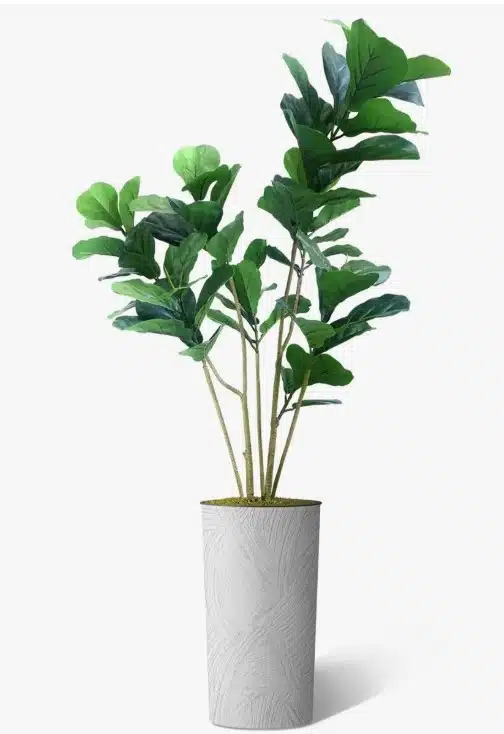
- Look & Vibe: It is bold, architectural and modern. The large leaves are used as a gigantic focal point, providing drama to a minimalistic space.
- Placement: Best fit in narrow spaces where you would prefer the plant to be tall, but not very wide.
3- Ficus Elastica: Best Faux Ficus Tree for Industrial Lofts
This ficus is thick and broad-leafed, somewhat shiny. Some varieties of it are variegated, with burgundy or pinkish margin on leaves. Artificial ones appear very realistic as the leaves are stiff by nature.
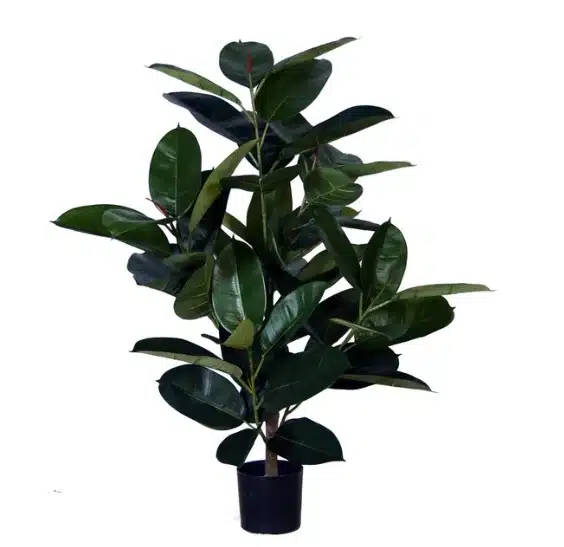
- Look & Vibe: This plant is more retro, sculptural and graphic compared to the others. Its leaves are simpler and more uniform in general giving it a clean bold shape.
- Placement: Good in a high-end, industrial or Art Deco-inspired room. The sturdier structure makes it appear very clean.
4- Braided-Trunk Ficus: Best Artificial Ficus Tree for Elegant Texture
It is a styling option that is common with the Weeping Fig type whereby several narrow trunks are loosely intertwined as the tree matures forming a distinctive and interwoven base.
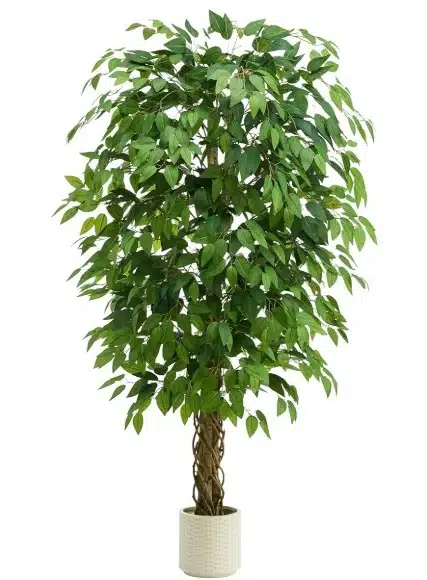
- Look & Vibe: The braided trunk gives it a little bit of texture and visual interest on the very bottom and makes it look more manicured and purposeful, almost European garden-like.
- Placement & Features: Placed where the base of the tree is easily visible which is the focal point—in close range corners, offices etc.
5- Mini Ficus: Best Faux Ficus Tree for Tabletop Zen
These are small Ficus, with a thick, artistic trunk, and a small, moulded canopy. They are normally placed on tables, shelves or desks as opposed to the floor.
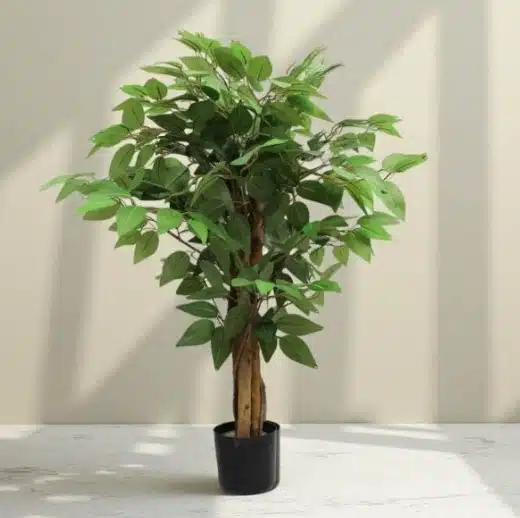
- Look & Vibe: These plants offer a calm, minimalist and luxurious experience that offers a calming, Zen feel to a room- an element of living art.
- Placement: The size difference is significant, so it’s used as an accent, on desktops, console tables, or as a centerpiece in other small spaces.
6- Ficus Alii: Best Artificial Ficus Tree for Narrow Hallways
This type is characterized by the thin and willow-like leaves that are far longer and thinner than the traditional Benjamina. It has a lighter, subtler texture that is graceful and light.
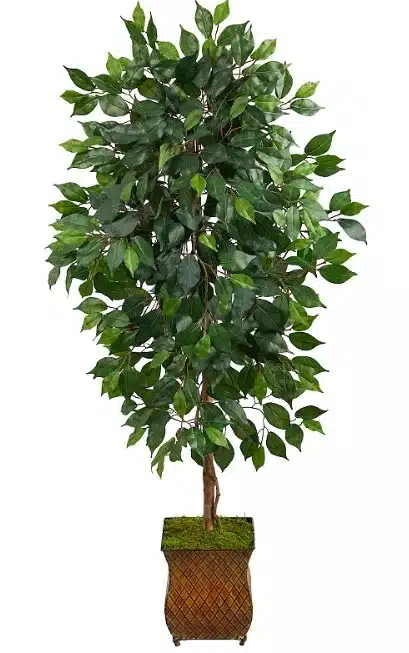
- Look & Vibe: It has a flowing look that is graceful. Its thin leaves form a feathery outline that is more sophisticated and not as busy as plants with round foliage.
- Placement: This is very good in areas of transition such as hallways and doorways, where you do not want to feel like the greenery is pushing you.
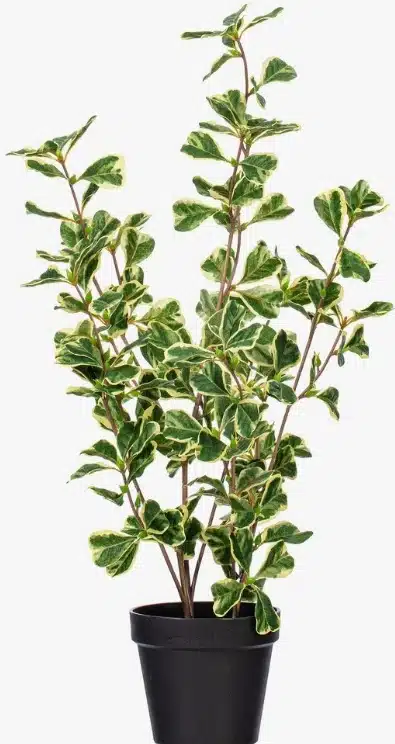
7- Variegated White Ficus: Best Fake Ficus Tree for Brightening Dark Corners
Another variation of the traditional Weeping Fig, this one has leaves that have creamy white or pale yellow edges. It resembles the appearance of a plant in the dappled sunlight.
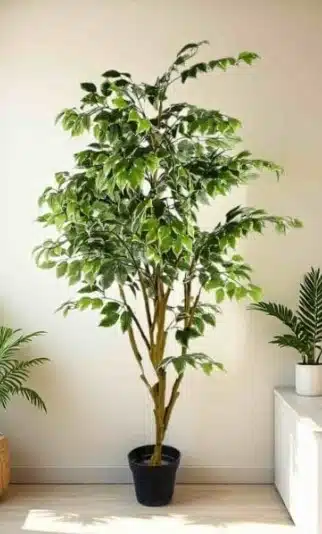
- Look & Vibe: It is light and happy, and it would be ideal in breaking up a palette of solid dark greens in a home jungle set up.
- Placement: This should be used in the darker areas of a room to make the illusion of light and lift the energy of the area.
8- Ficus Audrey: Best Artificial Ficus Tree for Sophisticated Balances
The Audrey is often referred to as the new Fiddle Leaf Fig, with the leaves being matte and velvety green with the veins standing out prominently. It is the national tree of India and it is becoming very popular in interior design.
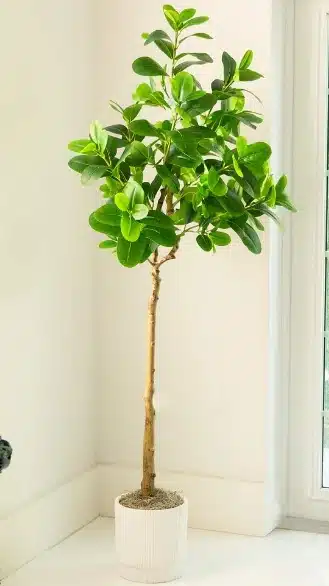
- Look & Vibe: It offers a more “true tree” aesthetic with an open structure. It is not as dramatic as the Fiddle Leaf but more substantial than the Benjamina and it is a perfect balance between classic and modern.
- Placement: Perfect as a single work of art in a living room or a dining room where one can view its balanced proportions on all sides.
9- Columnar Fiddle Leaf Fig: Best Fake Ficus Tree for Vertical Accents
The standard Fiddle Leaf tends to branch off at the top, but the columnar one is trained to produce leaves all along the trunk, forming a literal pillar of green.
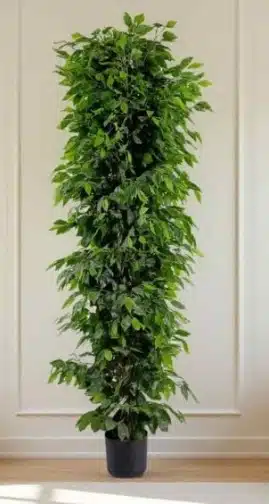
- Look & Vibe: Very architectural and high-fashion. It focuses on vertical lines and produces a very clean and organized look of a room.
- Placement: These are the final corner fillers to high ceilinged rooms or narrow spaces between windows where width is restricted.
10- Burgundy Rubber Tree: Best Artificial Ficus Tree for Dramatic Contrast
This is a particular color shade of the Rubber Plant. The leaves are deep chocolatey-maroon or almost black in hue and have a dark, dramatic appearance.
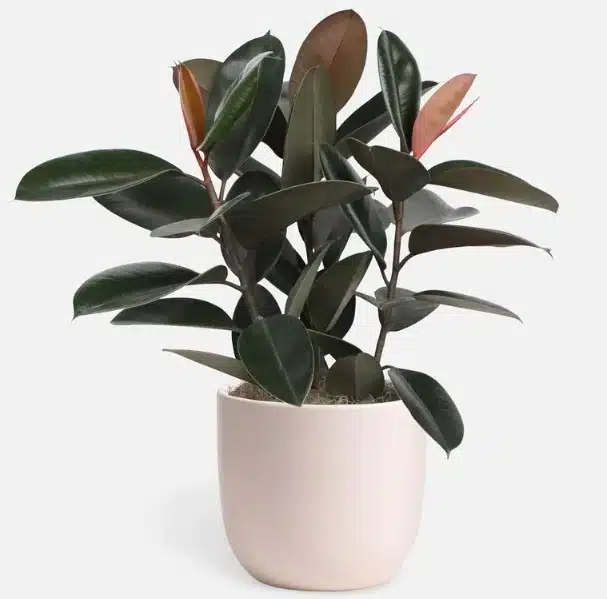
- Look & Vibe: Bold and masculine. The dark shiny leaves are a very beautiful contrast to white or light colored walls and serve as almost a dark piece of furniture.
- Placement: The placement is most appropriate in contemporary offices or dark-themed rooms that have brass hardware or leather furniture.
11- Mop-Top Ficus: The Most Artistic Fake Ficus Tree for Symmetry
Characterized by thick, rounded canopy of small leaves on a slender, straight trunk. This trim look provides a clean, geometrical appearance that is ideal in official doorways or in pairs.
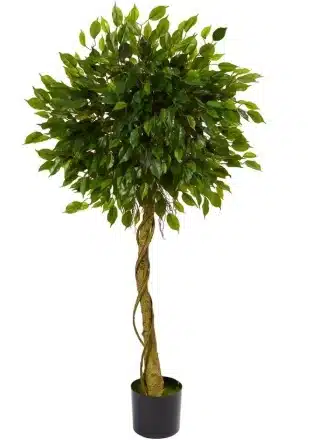
- Look & Vibe: Clean, tidy, and classy. It offers an organized burst of green that is deliberate and luxurious, like a classic European garden topiary.
- Placement: Suits flanking front doors, hallways, or can be placed in symmetrical pairs in a formal dining room to give the impression of balance.
12- Wild-Stem Ficus: A Realistic Artificial Ficus Tree for Home
This variety emphasizes an airy, asymmetrical growth pattern with sporadic leaf clusters. It is made to look like a tree that is growing in the wilderness, without the unnatural perfection of cheaper models.
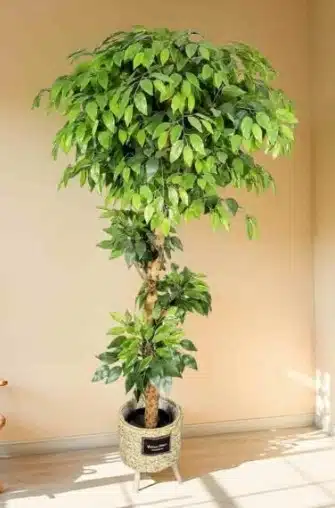
- Look & Vibe: Natural, casual and light. It brings a sense of the wild nature to a room without making it look heavy or cluttered, ideal in the effortless styling.
- Placement: Ideal in sunrooms or other spaces that have a boho-chic or rustic feel where a less refined and more casual appearance of a plant is needed.
13- Multi-Trunk Ficus Lyrata: Premium Faux Ficus Tree for Large Spaces
Unlike the single-stem version, this features multiple trunks branching from the base. It is fuller and bushier and occupies horizontal space more effectively than vertical space.
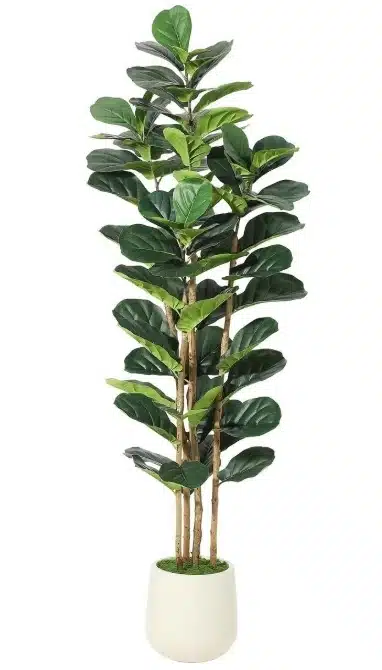
- Look & Vibe: Massive, rich and majestic. It supports the overall design of a room and contributes a lot of depth.
- Placement: This is most suitable in large open-plan living rooms or office lobbies where you need a large greenery footprint to fill an empty high-ceilinged corner.
14- Narrow-Leaf Ficus Bush: Compact Fake Ficus Tree for Shelving
A shorter, denser version of the Alii variety. It features long, slender leaves but in a shrub-like form, making it much more versatile for elevated surfaces rather than the floor.
- Look & Vibe: Delicate and feathery. It provides a soft texture that breaks up the hard edges of bookshelves or entertainment centers beautifully without dominating the space.
- Placement: Ideal for placing on mantels, deep windowsills, or as a lush filler on top of kitchen cabinets to draw the eye upward.
15- Spiral-Stem Ficus: Unique Artificial Ficus Tree for Topiary Lovers
Another variation on the braided trunk, in which one or two trunks are trained into a narrow spiral. It is a blend of botanical beauty and a bit of whimsical, artistic workmanship.

- Look & Vibe: Whimsical and decorative. It acts as a conversation piece, blending the line between a natural plant and a sculpted art installation with its flowing lines.
- Placement: Great for home offices or modern corners that need a vertical element with a bit of “personality” and visual movement.
Choosing the Best Artificial Ficus Trees (Step-by-Step Guide)
So now we shall proceed to the considerations that are imperative when choosing a good quality faux Ficus.
Step 1 — Measure Your Space
A tree that is excessively large will overwhelm the room and one too small will be lost and misplaced.
- Height: The common rule is to maintain at least one foot distance between tree and ceiling. For standard ceilings, a 5–6 ft ficus tree should feel balanced.
- Width/Spread: Measure the space on the floor to make sure the canopy would not encroach upon any walking space. When planting the tree under a wall sconce, beside a window or under an air vent, be careful not to have the leaves come in contact with the surfaces.
Step 2 — Match With Your Interior
As it was mentioned above, various Ficus species have varying aesthetic values..
- Modern/Minimalist: Go for the Ficus Lyrata or Ficus Elastica. Their huge and simple leaves and straight lines introduce a contemporary element.
- Traditional/Bohemian: The Ficus Benjamina is perfect here. Its dense, somewhat untidy and natural shape adds to a vintage and luxurious feel. The braided-trunk can also be used in more formal traditional rooms.
- Eclectic/Global: A smaller, statement piece like the Bonsai-Style Ficus will add a touch of Asian or Zen influence.
Step 3 — Evaluate Realism
Leaves are the first thing people notice. Cheap artificial ficus trees usually fail here. Always look closely at the product photos and read detailed descriptions focused on these three areas:
- Leaf Quality: The leaves should not be uniformly bright green. The expensive trees have different color tones of green (lighter on the new growth, darker on the old leaves) and minor flaws such as small veins. Flat, shiny, or overly dark leaves are a giveaway.
- Branching Structure: Real ficus trees don’t grow perfectly symmetrical. Artificial ones should not either. Your tree should have multiple branch levels and flexible inner wires that can be spread as needed. The junctions of the leaves and the branches must appear to be natural.
- Trunk Material: The best trunks are often made from real, preserved wood or resin molded with natural texture, knots, and colour variations. A smooth, painted plastic trunk will immediately give it away as a cheap copy.
Step 4 —Silk vs PE vs Real-Touch Materials
The term “silk” is often used generically as a realistic material. However, modern faux foliage today uses much better polymer materials.
| Material Type | How It Looks and Feels | Pros | Cons |
| Silk/Fabric | Light, thin fabric; made of a poly blend, very common for Weeping Fig. | -Lightweight-Allows for complex dyeing patterns. | -Can fray over time-Easily detects dust-Can look cheap/shiny |
| PE (Polyethylene) | Made of injection-moulded plastic, very durable | -Stable to achieve 3D shape and thickness-Very tough-UV-resistant options | -Lower quality feels stiff-Slightly higher initial cost. |
| Real-Touch (PE/Latex) | Blend of two, made with a thin latex or PU coating. | -Imitates the fine texture and the fullness of an actual leaf. | -Higher cost-Can degrade slightly over many years compared to pure PE. |
Step 5 — Check Potting, Base Weight, and Stability
A ficus, especially tall ones, requires a heavy base for stability.
- Most artificial ficus trees come in basic nursery pots. This is really good, as you can put them in a decorative planter or basket which is compatible with your interior.
- Whatever pot you have, make sure it is weighted (normally using cement or plaster) to ensure that the tree is straight. In case the tree is high (6 feet or more), it should be weighted and wide.
- The “soil” should be neatly finished, often covered with preserved moss or little pebbles, which contributes to the effect of being in a pot.
Step 6 — Vendor Reputation + Return Policies
Often you cannot physically inspect the tree, so the vendor’s guarantee is your safety net. Do not use unfamiliar or purely dropshipping websites.
- Give preference to retailers or manufacturers (such as HRtrees) of home decor and artificial plants, since they tend to have greater quality control and better materials.
- Modern artificial ficus tree manufacturers also provide UV-treatments, paramount if you plan to place the tree under sunlight exposure.
- Returns are usually easy but shipping back large trees can be expensive. Check damage and replacement policies before ordering.
How to Maintain Your Artificial Ficus Tree?
Maintaining your artificial ficus tree is simple but essential for longevity. Unlike real plants, these require no water, but they do need regular grooming:
- Dusting: Every few weeks, use a microfiber cloth or feather duster. For Real-Touch leaves, a wet cloth is the best to use so as to give them their natural, healthy-looking shine.
- Reshaping: The majority of high-quality trees are internally wired; bend branches back into an asymmetrical and natural-looking form when it changes or appears too compressed with time.
- Deep Cleaning: Once every year, spray a mild soap-and-water solution or a special artificial plant cleaner spray to get rid of any tough dirt or household film.
- UV Protection: When placed near windows, spray on UV-resistant paint once a year. This prevents fading of pigments and brittle nature of materials when they are exposed to direct sunlight.
Key Takeaways
- The best artificial Ficus trees are constructed with quality, have realistic features and they suit your room in terms of style and size.
- Material choice affects durability and price more than looks. For the best tactile realism, choose trees made with modern PE or “Real-Touch” materials.
In need of high-quality artificial ficus trees with realistic features and quality production? Get in touch with us at HRtrees. We offer a wide variety of plants to fit any space and style.